Generate a conforming triangle mesh from a 2:1 balanced p4est. More...
#include <p4est_lnodes.h>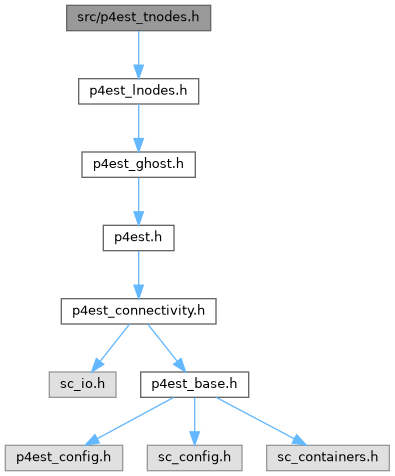
Go to the source code of this file.
Data Structures | |
| struct | p4est_tnodes |
| Lookup table structure defining a conforming triangle mesh. More... | |
Macros | |
| #define | P4EST_TNODES_SIMPLEX_CORNERS 3 |
| Number of corners of a simplex. | |
| #define | P4EST_TNODES_CUBE_SIMPLICES 2 |
| Number of coarse simplices in a cube. | |
Typedefs | |
| typedef struct p4est_tnodes | p4est_tnodes_t |
| Lookup table structure defining a conforming triangle mesh. | |
Functions | |
| int | p4est_tnodes_simplex_parent (int p, int c, int k) |
| Compute the number of the parent simplex that contains this one. | |
| int | p4est_tnodes_simplex_parent_is_valid (int p, int kp, int c, int kc) |
| Verify that a given child simplex is contained in a parent. | |
| int | p4est_tnodes_quadrant_Q1_simplices (p4est_lnodes_code_t fc, int pc) |
| Based on a face code and the parent's id, calculate simplex count. | |
| int | p4est_tnodes_quadrant_Q2_simplices (p4est_lnodes_code_t fc) |
| Based on the face code of an element, calculate contained simplices. | |
| p4est_tnodes_t * | p4est_tnodes_new_Q1_P1 (p4est_t *p4est, p4est_lnodes_t *lnodes) |
| Generate a conforming triangle mesh from a Q1 lnodes structure. | |
| p4est_tnodes_t * | p4est_tnodes_new_Q2_P1 (p4est_t *p4est, p4est_lnodes_t *lnodes) |
| Generate a conforming triangle mesh from a Q2 lnodes structure. | |
| p4est_tnodes_t * | p4est_tnodes_new_Q2_P1_ind (p4est_t *p4est, p4est_lnodes_t *lnodes) |
| Generate a conforming triangle mesh from a Q2 lnodes structure. | |
| size_t | p4est_tnodes_memory_used (p4est_tnodes_t *tnodes) |
| Calculate memory allocated in a tnodes structure. | |
| void | p4est_tnodes_destroy (p4est_tnodes_t *tnodes) |
| Free the memory in a conforming triangle mesh structure. | |
Variables | |
| const int | p4est_tnodes_simplex_reverse [2] |
| The number of the congruent simplex that starts at the antipode. | |
Detailed Description
Generate a conforming triangle mesh from a 2:1 balanced p4est.
This mesh is based on a given p4est_lnodes structure. Additional lookup tables define the simplex mesh.
Please see a textual overview under Conforming simplex export.
Typedef Documentation
◆ p4est_tnodes_t
| typedef struct p4est_tnodes p4est_tnodes_t |
Lookup table structure defining a conforming triangle mesh.
Trying to conform to latest status of paper repository:
7c96f3bbefad364e3fa657272bca757d13d82a82
d43b2e54f939b186ef765c65638fde2fe792aa55
6bc25f04355eef8d73ec53bdcf6f5915a5748559
711e76748721665bdebb3d5f0bfd53dbd1702a8e
In the meantime, we have added a Q2 recursive bisection construction that works in both 2D and 3D and is identical to a Q2-via-Q1 method. Starting a fresh paper repository for the latest writeup:
6db206b36bcbc3f602bfce39ef03756b9cc2c845
63402d42f575eab6b201206e089fcb05e538da80
3ebb195e4cefebdb993b3f30f28603e7dbd277b0
2ec5cf52f7da2159aa983e6c34ffb3e1c13f741b
Function Documentation
◆ p4est_tnodes_destroy()
| void p4est_tnodes_destroy | ( | p4est_tnodes_t * | tnodes | ) |
Free the memory in a conforming triangle mesh structure.
- Parameters
-
[in] tnodes Memory is deallocated. Do not use after return.
◆ p4est_tnodes_memory_used()
| size_t p4est_tnodes_memory_used | ( | p4est_tnodes_t * | tnodes | ) |
Calculate memory allocated in a tnodes structure.
- Parameters
-
[in] tnodes Valid tnodes structure.
- Returns
- Total memory allocation in bytes.
◆ p4est_tnodes_new_Q1_P1()
| p4est_tnodes_t * p4est_tnodes_new_Q1_P1 | ( | p4est_t * | p4est, |
| p4est_lnodes_t * | lnodes | ||
| ) |
Generate a conforming triangle mesh from a Q1 lnodes structure.
- Parameters
-
[in] p4est Forest underlying the mesh. It must not contain any root-level elements: to avoid this, it should be refined a priori. [in] lnodes Valid node structure of degree 1. Must be derived from the p4est.
- Returns
- Valid conforming triangle mesh. Each triangle overlaps one or more elements. It is assigned to exactly one of their owner processes. The triangles are right-handed with respect to the tree coordinate system containing their element.
◆ p4est_tnodes_new_Q2_P1()
| p4est_tnodes_t * p4est_tnodes_new_Q2_P1 | ( | p4est_t * | p4est, |
| p4est_lnodes_t * | lnodes | ||
| ) |
Generate a conforming triangle mesh from a Q2 lnodes structure.
- Parameters
-
[in] p4est Forest underlying the mesh. It must not contain any elements at P4EST_QMAXLEVEL. To avoid this, it should not be refined that deep. [in] lnodes Valid node structure of degree 2. Must be derived from the p4est.
- Returns
- Valid conforming triangle mesh. Each triangle is contained in exactly one process. The triangles are right-handed with respect to the tree coordinate system containing their element.
◆ p4est_tnodes_new_Q2_P1_ind()
| p4est_tnodes_t * p4est_tnodes_new_Q2_P1_ind | ( | p4est_t * | p4est, |
| p4est_lnodes_t * | lnodes | ||
| ) |
Generate a conforming triangle mesh from a Q2 lnodes structure.
This function uses a method distinct from p4est_tnodes_new_Q2_P1 but produces an identical result. It is useful for verification.
- Parameters
-
[in] p4est Forest underlying the mesh. It must not contain any elements at P4EST_QMAXLEVEL. To avoid this, it should not be refined that deep. [in] lnodes Valid node structure of degree 2. Must be derived from the p4est.
- Returns
- Valid conforming triangle mesh. Each triangle is contained in exactly one process. The triangles are right-handed with respect to the tree coordinate system containing their element.
◆ p4est_tnodes_quadrant_Q1_simplices()
| int p4est_tnodes_quadrant_Q1_simplices | ( | p4est_lnodes_code_t | fc, |
| int | pc | ||
| ) |
Based on a face code and the parent's id, calculate simplex count.
- Parameters
-
[in] fc Valid face code as defined in p4est_lnodes.h. [in] pc Child id of quadrant's parent.
- Returns
- Element simplex count between 1 and 2 inclusive.
◆ p4est_tnodes_quadrant_Q2_simplices()
| int p4est_tnodes_quadrant_Q2_simplices | ( | p4est_lnodes_code_t | fc | ) |
Based on the face code of an element, calculate contained simplices.
- Parameters
-
[in] fc Valid face code as defined in p4est_lnodes.h.
- Returns
- Element simplex count between 6 and 8 inclusive.
◆ p4est_tnodes_simplex_parent()
| int p4est_tnodes_simplex_parent | ( | int | p, |
| int | c, | ||
| int | k | ||
| ) |
Compute the number of the parent simplex that contains this one.
- Parameters
-
[in] p Child id of parent element in [0, 4). [in] c Child id of child element in [0, 4). [in] k Number of simplex in [0, 2) within child. return Number of simplex in [0, 2) within parent.
◆ p4est_tnodes_simplex_parent_is_valid()
| int p4est_tnodes_simplex_parent_is_valid | ( | int | p, |
| int | kp, | ||
| int | c, | ||
| int | kc | ||
| ) |
Verify that a given child simplex is contained in a parent.
- Parameters
-
[in] p Number of parent element in [0, 4). [in] kp Number of simplex in [0, 2) within parent. [in] c Number of child element in [0, 4). [in] kc Number of simplex in [0, 2) within child.
- Returns
- True if contained, false if not.
Variable Documentation
◆ p4est_tnodes_simplex_reverse
|
extern |
The number of the congruent simplex that starts at the antipode.
There is exactly one simplex that starts at the antipode corner for every one starting at the anchor corner, in reverse order.